
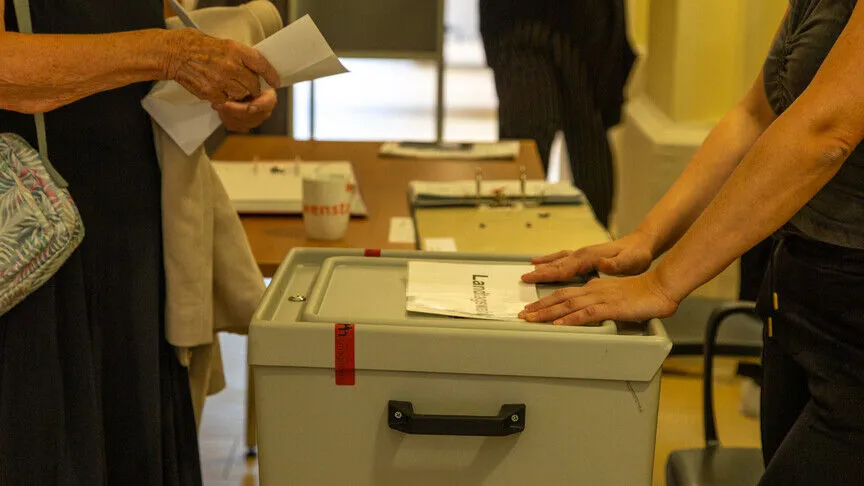
According to temporary official results, the AfD, which secured 39 deputies in the 83-seat Saxony-Anhalt State Parliament, fell 3 seats short of an absolute majority of 42 seats.
The AfD more than doubled its vote share from 20.8% in 2021. The Christian Democratic Union (CDU), on the other hand, lost 19.9 points, falling to 17.2%.
According to polls, the AfD is also emerging as the leading candidate in Mecklenburg-Vorpommern, while in Berlin, four parties are ranked within a few percentage points of each other. In neither state is it guaranteed that the party finishing first will form the government.
Four-Party Race in Berlin
The parliamentary election in Berlin will determine the structure of the state government. The election will also be one of the first indicators of the impact the Saxony-Anhalt result has created in federal politics.
In a poll conducted by Infratest dimap for public broadcaster Rundfunk Berlin-Brandenburg (RBB), the CDU received 21% support, the Left Party 19%, and the AfD and Greens each 18%. The Social Democratic Party (SPD), a junior partner in the federal government, saw its vote share drop to 11%, while the Bündnis Sahra Wagenknecht (BSW) remained at 4%.
In INSA's latest survey, support for the CDU was recorded at 20%, the Left Party at 19%, and the AfD at 18%. The SPD and the Greens each received 15% support.
These figures indicate that the current CDU-SPD government will lose its majority. It is considered possible that CDU-SPD-Greens or Left Party-SPD-Greens coalitions could be formed after the election.
Due to the CDU, SPD, Left Party, and Greens rejecting a coalition with the AfD, the party does not appear to have a partner capable of forming a government, even if it finishes first in the election.
Experts, however, predict that the Saxony-Anhalt victory could give the AfD momentum, while also mobilizing anti-AfD voters around the Left Party or the Greens.
While housing and rent prices constitute the main local agenda of the election campaign in Berlin, the proportion of those dissatisfied with the current CDU-SPD government reaches 77%.
Gap Between AfD and SPD Narrows in Mecklenburg-Vorpommern
In the latest poll conducted by Infratest dimap for public broadcaster NDR, the AfD received 35% support, and the SPD of current State Premier Manuela Schwesig received 32%.
According to the poll results, the Left Party reached 11%, the CDU 8%, the Greens 5%, and the BSW 4% of the vote.
In Forsa's survey for Ostsee-Zeitung, the AfD received 37% support, the SPD 28%, the Left Party 11%, the CDU 10%, the Greens 5%, and the BSW 4%.
In both surveys, the SPD-Left Party government is losing its majority.
While the Infratest dimap results would allow for an SPD-Left Party-Greens coalition if the Greens cross the 5% threshold, the figures in the Forsa survey are insufficient for this trio.
Despite the AfD leading in party preferences, 56% of voters prefer an SPD-led government, while 31% prefer an AfD-led government. If the state premier were directly elected by the people, 60% would choose Schwesig, while support for AfD candidate Leif-Erik Holm remained at 25%.
The CDU's rejection of a coalition with both the AfD and the Left Party could complicate the government formation process if the SPD-Left Party-Greens alliance fails to achieve a majority.
BSW's Stance Could Affect Government Calculations
Whether the BSW, polling at 4% in both states, crosses the electoral threshold could change the distribution of seats and government options.
Thomas Schulze, the BSW's lead candidate in Saxony-Anhalt, announced that they would hold talks with all parties, including the AfD, after the elections. The abstention of BSW deputies in a potential third round of the state premier election could pave the way for the AfD candidate, as the candidate with the most votes is elected in this round.
The Mecklenburg-Vorpommern BSW organization announced that it would not form a coalition with the AfD, advocating instead for a government model with a non-partisan premier and ministers chosen based on their expertise. The organization states that in this model, cooperation on concrete issues could be possible with all parties represented in parliament, including the AfD.
On the other hand, the BSW's approach to cooperation with the AfD and disagreements with the federal leadership have deepened the division within the party. In Thuringia, 13 of the 15 deputies elected from the BSW list left the party. Former BSW members around Katja Wolf founded a new party called "Thüringen. Gerecht," while 10 deputies plan to form a new parliamentary group under the same name.
Pressure Mounts on Merz
The Saxony-Anhalt result is also considered a heavy political defeat for Prime Minister and CDU Chairman Friedrich Merz.
Merz stated that the CDU leadership experienced "deep shock" at the result, saying it was the party's "heaviest defeat in years, even decades."
Merz, acknowledging that his own leadership was a significant topic of debate during the election campaign, stated his determination to continue the economic and social reform program, saying, "Giving up is not an option for me."
In the September ARD-DeutschlandTrend survey, only 13% of Germans stated they were satisfied with Merz's work, while 83% expressed negative views. The AfD ranked first nationwide with 27%, while the CDU and CSU remained at 21%.
From the SPD, the other partner in the federal government, statements emerged that the election result was a message to the federal government and that pension, care system, and budget policies needed to be re-evaluated.
The elections in Berlin and Mecklenburg-Vorpommern are seen as a new "test" for Merz and the federal government, as they will show whether the CDU's defeat in Saxony-Anhalt will remain limited to a single state.

Comments
0 commentsNo comments on this article yet. Be the first!