
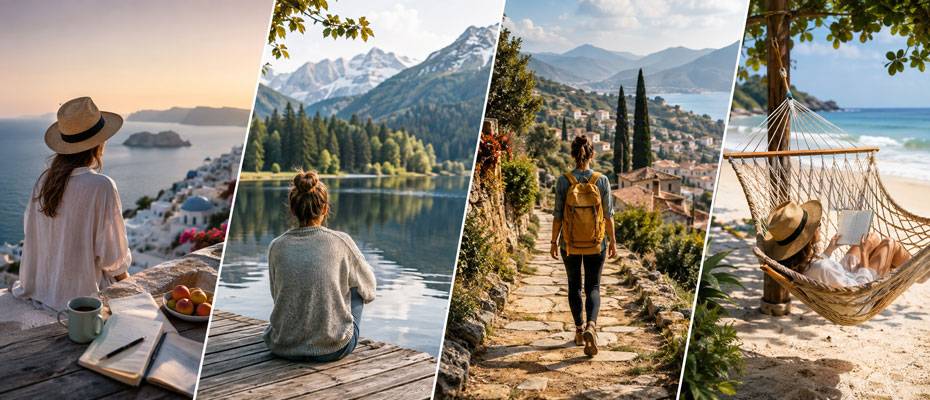
Europeans' expectations for holidays are changing. Spending more time in one destination instead of seeing as many places as possible with packed schedules, getting away from the digital pace of daily life, and shaping travel according to personal needs are gaining increasing importance. The third part of the DERTOUR Group European Travel Trend Report reveals that Slow Travel and solo travel are two prominent elements of this change.
The research is based on a survey conducted with 8,000 people in 13 European markets, as well as DERTOUR Group's booking data and expert assessments from 16 European source markets.
“Reisen bedeutet seit jeher, Neues zu entdecken. Heute jedoch legen Reisende mehr Wert denn je auf Erlebnisse, die ihnen etwas bedeuten und die in Erinnerung bleiben. Ob Slow Travel, Digital-Detox-Auszeiten oder Solo-Reisen: Europäische Reisende entdecken neue Arten des Reisens, die ihren individuellen Bedürfnissen und Interessen entsprechen”, says Christoph Debus, CEO of DERTOUR Group.
53% of Europeans are interested in Slow Travel
According to the research, 53.2% of Europeans are interested in the Slow Travel approach, which consciously means traveling more slowly. Approximately 64% of participants stated that they specifically want to slow down their pace on holiday, while this rate approaches 68% in Germany.
More than 58% of Europeans prefer fewer but more memorable experiences instead of numerous small activities. More than 55% want to get to know the people, nature, and culture of the place they visit more closely.
Approximately 59% of those interested in Slow Travel prefer this form of travel to experience the destination more intensely. In Austria, the rate of those wanting to spend more time at their holiday destination exceeds 67%, with the country, along with Norway, reaching one of Europe's highest values in this regard.
“Viele Menschen möchten weiterhin neue Reiseziele entdecken. Gleichzeitig wächst der Wunsch, sich Zeit zu nehmen, einen Ort wirklich kennenzulernen, anstatt möglichst viel auf einmal sehen zu wollen”, Debus explains.
Slower travel means less stress
52% of Europeans associate the Slow Travel approach with personal well-being and less stress. Approximately 23% believe that slower travel allows for more intense encounters with local people and cultures.
Cost is also among the reasons for preference. Approximately 23% of Europeans believe that Slow Travel can help save on holiday budgets. In Germany, this rate approaches 28% in the 45-55 age group, exceeding the European average for the same age group by approximately seven points.
New products catering to this trend are also emerging in the industry. While Meiers Weltreisen's “Go with the Flow” tours combine organized travel with individual freedom of movement, ananea hotels' “Slow Glamour” concept focuses on a more conscious and tranquil holiday experience.
One in two Europeans wants to disconnect from the digital world on holiday
The desire to slow down is also reflected in smartphone and social media usage. 48.9% of Europeans view holidays as an opportunity to completely or largely disconnect from social media and digital distractions.
This trend is particularly strong among the Millennial generation. In Europe, more than half of the 25-44 age group sees travel as an opportunity for a digital break. In Germany, this rate exceeds 53% in the 35-44 age group.
“Reisen bietet vielen Menschen etwas, das im Alltag oft schwer zu finden ist: ungestörte Zeit. Sich für eine Weile von Bildschirmen, Terminen und Routinen zu lösen, gehört für viele inzwischen fest zum Urlaub dazu”, says Debus.
Approximately 30% of Europeans are open to solo travel
Although family holidays remain Europe's most popular form of travel at approximately 66%, solo travel is rapidly gaining importance. Approximately 30% of participants state that it is likely or very likely they will travel alone within the next 12 months.
While this rate approaches 38% among singles, approximately one-quarter of those in a stable relationship are also considering solo holidays. Thus, solo travel is moving away from being a form of holiday limited to people living alone or without a relationship.
Germany leads Europe in solo travel
The highest interest in solo travel is observed in Germany, with a rate exceeding 36%. Germany is followed by Sweden with 35%, France with 32.2%, the United Kingdom with 29.8%, and Poland with 28.9%.
“Solo-Reisen etablieren sich zunehmend als fester Bestandteil der europäischen Reiselandschaft. Besonders interessant ist dabei, dass dieser Trend Menschen unterschiedlicher Generationen, Lebensstile und Reisevorlieben verbindet. Für viele bedeutet Alleinreisen vor allem Freiheit, Flexibilität und die Möglichkeit, den Urlaub nach den eigenen Vorstellungen zu gestalten”, says Debus.
Solo guests want real single rooms
The increasing interest in solo travel is also changing expectations from hotels and tour operators. More than 38% of Europeans planning to travel alone within the next 12 months want genuine single room options without extra charges.
Approximately 28% of participants value options that allow them to travel with people sharing similar interests, while more than 22% are looking for opportunities to meet other solo guests. Approximately 27% expect personalized offers and carefully curated experiences.
Safety is also among the important criteria. More than 25% of those interested in solo travel want a fixed contact person they can reach in emergencies, while approximately 22% value additional security services.
Tour operators expand solo travel products
Tour operators within DERTOUR are responding to the increasing demand with special solo tours, discounted single room supplements, and options that allow for sharing double rooms. Special products for solo travelers are also offered on some cruise trips.
“Gemeinsame Mahlzeiten, interaktive Programmpunkte und kleine Reisegruppen fördern den Austausch mit anderen Teilnehmenden und schaffen zugleich Raum für besondere Erlebnisse, die lange in Erinnerung bleiben”, says Sven Schikarsky, General Manager Product at DERTOUR Germany.
The research results show that in the European travel market, more personal and meaningful experiences are increasingly replacing a greater number of experiences. Although Slow Travel, digital breaks, and solo travel stand out as different trends, their common point is that the pace and content of the holiday are determined by the traveler's individual needs. Image: © AI-generated image


Comments
0 commentsNo comments on this article yet. Be the first!