
While two of these sites will gain UNESCO status in July 2026, a decision for Wanuskewin in Canada is expected in 2028.
Resilient corals on the edge of the desert in Jordan
The Aqaba Marine Reserve at the northern tip of the Red Sea will be included in the UNESCO World Natural Heritage list in July 2026. Known as the world's northernmost tropical coral reef system, this region is home to over 150 species of hard corals, more than 500 fish species, and approximately 1,000 mollusk species.
The corals here have adapted over thousands of years to high salinity levels and extreme rises in sea temperatures. The ecosystem, which can be explored by diving and snorkeling, offers a completely different natural world just a few kilometers from Jordan's desert landscape.
Tombs of the steppe empire in Mongolia
Monumental tomb complexes in the Mongolian steppes bear the traces of the Xiongnu elite, who established Central Asia's first great nomadic equestrian empire. These sites will be added to the UNESCO World Heritage list in July 2026.
Horse harnesses, chariots, weapons, tools, and grave goods found in the tombs offer significant insights into the lifestyle and social structure of a society that influenced Eurasian history for centuries. With the addition of these new sites, the number of UNESCO World Heritage sites in Mongolia will reach seven.
Bison uncovered petroglyphs in Canada
In Wanuskewin Heritage Park, north of Saskatoon, bison are at the forefront of an unusual archaeological discovery. The animals, reintroduced to the area in 2019, revealed markings on a stone that had long been buried under the prairie soil when they rolled in the dirt a year later. Investigations identified four petroglyphs.
A total of 19 archaeological sites are located in the area where Opimihaw Creek meets the South Saskatchewan River. Campgrounds, bison hunting grounds, tipi rings, and North America's northernmost documented medicine wheel bear witness to approximately 6,400 years of human history in the valley.
A decision regarding Wanuskewin, which is on Canada's UNESCO tentative list, is expected in 2028. If accepted, it will be Saskatchewan's first UNESCO World Heritage site.
From caves to medieval castles in Germany
In the Nürnberger Land region, traces from different periods can be seen in close proximity. Rothenberg Castle, Hohenstein Castle, the karst caves of Frankenalb, and the prehistoric settlement of Hunas near Hartmannshof are among the region's important historical sites.
Museums, guided tours, and theater performances held at historical sites connect this heritage with today's visitors. The region's history stretches from early human settlements to the medieval “Golden Road” connecting Nuremberg and Prague.
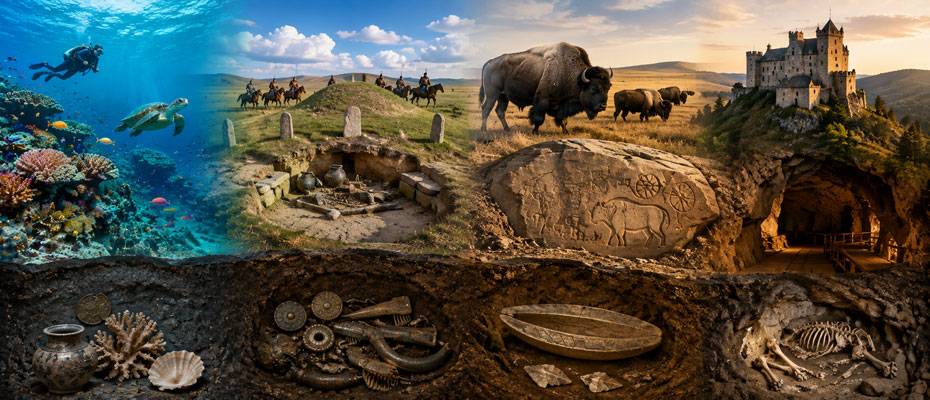
Traces hidden beneath the Red Sea, in the Mongolian steppes, under Canada's prairie soil, or in the caves of Frankenalb show that history and natural landscape are sometimes inseparable. Image: © AI-generated image

Comments
0 commentsNo comments on this article yet. Be the first!