
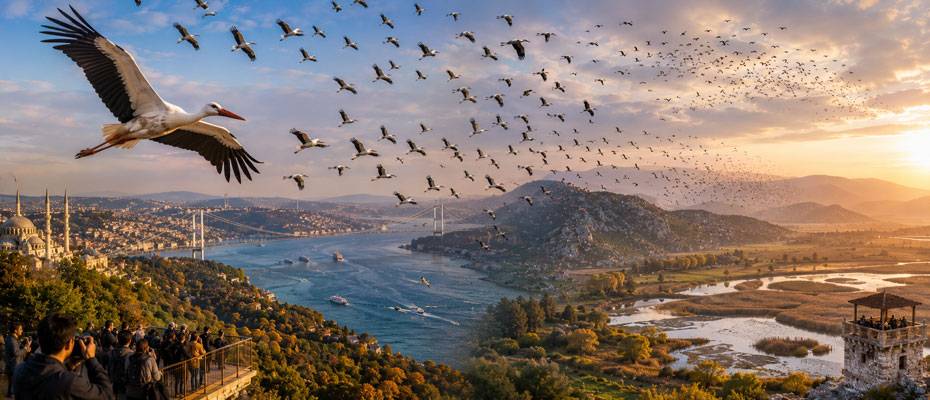
Black dots appearing in the skies of Istanbul at the end of summer mark the beginning of hundreds of storks' journey to Africa. The birds rise by circling in the same air current and glide towards Anatolia without flapping their wings. Thus begins the autumn journey of storks migrating from Europe to Africa over Turkey.
Turkey is one of the important transit countries on the eastern migration route of the white stork (Ciconia ciconia). Most storks breeding in Europe use the Bosphorus instead of crossing the Mediterranean. The birds traverse Anatolia in a southeasterly direction, reaching Hatay. From there, they continue their migration to Africa via the Levant and the Nile Valley.
This journey offers an extraordinary nature experience not only for birdwatchers but also for tourists visiting Turkey in late summer and early autumn. Moreover, some of the most important scenes of the spectacle are located right next to major tourism centers like Istanbul.
The Bosphorus Sky Fills with Storks
Storks use thermals, which are formed by rising warm air, to conserve energy during long-distance migration.
Birds rising hundreds of meters by circling within a thermal then glide towards the next rising air current without flapping their wings. For this reason, they need to avoid long sea crossings.
The Bosphorus acts as a natural bridge at precisely this point. Scientific research reveals that the Bosphorus is one of the main crossing points for soaring migratory birds in Europe. There have been years when 119,381 white storks were counted in a single season during spring surveys.
In autumn, the migration proceeds in the opposite direction. Istanbul's historical skyline also provides a unique backdrop for this natural phenomenon. It is possible to see large flocks of storks above mosques, minarets, the Bosphorus, and the city's modern structures.
Where Can Stork Migration Be Watched in Istanbul?
One of the best-known spots for autumn migration is Büyük Çamlıca Hill in Üsküdar. The 288-meter-high hill, which dominates the southern part of the Bosphorus, provides an opportunity to observe not only storks but also black storks, honey buzzards, lesser spotted eagles, short-toed snake eagles, and other soaring migratory birds, especially in September and October. Scientific stork counts were also carried out here.
To the north of the Bosphorus, the areas around Sarıyer and Garipçe gain importance, especially during spring migration. Intense bird movements can be observed in the corridor extending around Sarıyer and Fener at the Black Sea entrance. Beykoz and Toygartepe are also listed among the observation points in Istanbul.
A separate experience for photographers can be had around Büyükçekmece, Çatalca, and Silivri. During the migration period, there are areas where thousands of storks roost collectively in the evenings and take to the air again with the thermals created by the morning sun.
From Istanbul to Hatay via Anatolia
The journey of storks crossing the Bosphorus does not end here. The birds proceed south over Anatolia, reaching the Eastern Mediterranean. Historical migration studies reveal that intense crossings in autumn are observed in Belen approximately 5 to 10 days after the Bosphorus. These data indicate that the migration speed over Anatolia can be approximately 100 kilometers per day.
Therefore, a birdwatching trip in Turkey can theoretically be turned into a route following the migration. The journey starting in Istanbul continues a few days later in a completely different geography in southern Anatolia.
Grand Finale in Hatay
One of the most impressive observation points in Turkey is Belen Pass in Hatay. The Amanos Mountains descend to approximately 700 meters here. This natural pass between the Gulf of Iskenderun and the Amik Plain has not only been one of the important routes between Anatolia and Syria for thousands of years for humans; migratory birds also use the same geographical gateway.
Research conducted in Belen recorded a total of over 150,000 soaring migratory birds during the spring and autumn periods. The data includes 82,887 white storks and 3,303 black storks, as well as thousands of pelicans, cranes, and raptors. Due to the region's importance, a 45-hectare area was declared Belen Pass Nature Park in 2014 with a birdwatching theme.
Belen's appeal for tourists does not stem solely from the numbers. With the Mediterranean and the Gulf of Iskenderun on one side and the Amik Plain on the other, hundreds of birds rising in the sky can create one of Turkey's most impressive natural spectacles.
The Best Time Depends on the Weather
Autumn migration generally becomes noticeable from late August and continues intensely throughout September; migratory bird observations can also be made in Istanbul in September and October. However, there is no guarantee of a precise time or day for stork observation. Wind, temperature, and thermals affect at what altitude and through which corridor the birds will pass.
Therefore, very early morning hours may not always be the best option. For soaring birds to rise in large flocks, the sun needs to heat the land and thermals need to form. Although binoculars are useful, large flocks of storks can often be easily observed with the naked eye.
For photographers, a wide-angle lens is as worthwhile to have in the bag as a medium and long telephoto lens. Because in Istanbul, the truly impressive shot is sometimes not a portrait of a single stork, but the giant spiral formed by hundreds of birds over the Bosphorus and the city skyline.
An Unexpected Safari in the Middle of Your Holiday
It is precisely this accessibility that makes Turkey's stork migration special. While a safari in Africa requires days of planning, in Istanbul, it is possible to scan the sky in Çamlıca a few hours after getting off the ferry. In Hatay, the bird migration in Belen can be added to a culture, gastronomy, and nature trip.
And the moment the scale of the movement in the sky is realized, the view changes. It is no longer just a few birds being seen. A segment of a thousands-of-kilometers-long journey from Europe to Africa, visible for only a few minutes, passes before the observer in the skies of Turkey.
Image: © AI-generated image



Comments
0 commentsNo comments on this article yet. Be the first!