
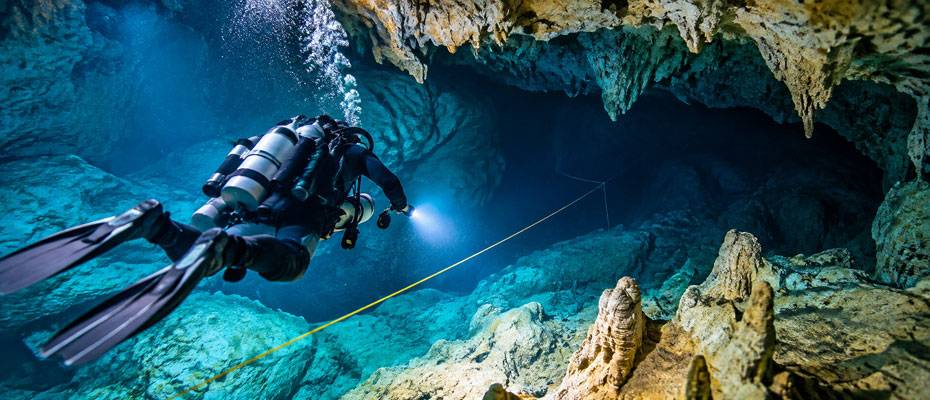
Technical dives were conducted in Suluin Cave in Finike district of Antalya. A depth of 117 meters was reached during these dives. Previously unexplored sections of the cave were investigated. Following the work, an uninterrupted guide line was laid from the reached point to the surface. This line created a safe route that teams entering the cave in the future can use.
The work was carried out between August 10-16 under the coordination of the Finike District Governorship. In addition to public institutions, volunteer search and rescue teams, the Karadeniz Divers Sports Club, and instructors from the Gallipoli Technical Diving Center participated. Dives in the cave, which was initially aimed to be explored up to a depth of 175 meters, were conducted gradually for safety reasons.
Each dive prepared the next stage
The work in Suluin was planned in successive stages rather than aiming to reach the greatest possible depth in a single dive. Information obtained from each dive was used to determine the objectives and safety conditions of the subsequent work.
Alper Burak Küçükkaramıklı, an instructor at Sona Underwater Technologies and a member of the dive team, stated that after obtaining official permits, they had the opportunity to re-explore and document the cave.
Küçükkaramıklı, who said they explored all accessible parts of the cave, “Going to the very end of the cave, laying our own guide line, and leaving a plate behind gave us an extremely great sense of satisfaction because no one else had gone to that point before us.”
Special breathing gases used at depth
One of the technically noteworthy aspects of the work was the breathing gases used in deep dives. Hydrogen was added to the breathing gases to reduce the risk of high-pressure nervous syndrome that can occur in mixtures containing a high percentage of helium.
A special mixture consisting of helium, hydrogen, and oxygen was also used during the research. The team noted that there was no publicly available record of this mixture being used in a dive in Turkey before.
In addition to closed-circuit trimix systems, various experimental gas mixtures and technical equipment were also tested. The dives allowed for the testing of new procedures under challenging cave conditions.
Search and rescue teams worked in a cave environment
The Suluin research was not planned solely as a study to explore unknown sections of the cave. Training and drills were also conducted to improve the capabilities of public institutions and civilian search and rescue teams in confined space diving.
Rıza Birkan, President of the Karadeniz Divers Sports Club and leader of the search and rescue team, stated that the collaboration of teams from different disciplines was one of the important elements of the operation. During the work, coordination and search and rescue capacity were also tested under challenging confined space conditions.
Ali Şener, a dive instructor and member of the underwater imaging team, stated that Turkish divers reaching previously unexplored sections of the cave with their own knowledge and technical capabilities is important in demonstrating the level technical diving has reached in Turkey.
Suluin's underwater world captured on camera
In the final section of the research, underwater footage was also taken to document the natural structure of the cave. The aim was for the images of the sections reached by the divers to be used not only in scientific and technical studies but also in promoting the region.
Murathan Yıldız, an instructor at the Gallipoli Technical Diving Center, said, “In these dives, we not only reached the deepest point of the cave but also captured beautiful images throughout our dives. We hope that not only we see these beauties, but everyone who follows these works can see them too.”
Suluin Cave in Finike has once again come to the forefront as one of the areas revealing a different tourism potential for Antalya, with both its advanced technical diving and search and rescue operations and its hidden underwater natural structure. Visual: © Image generated with artificial intelligence

Comments
0 commentsNo comments on this article yet. Be the first!