
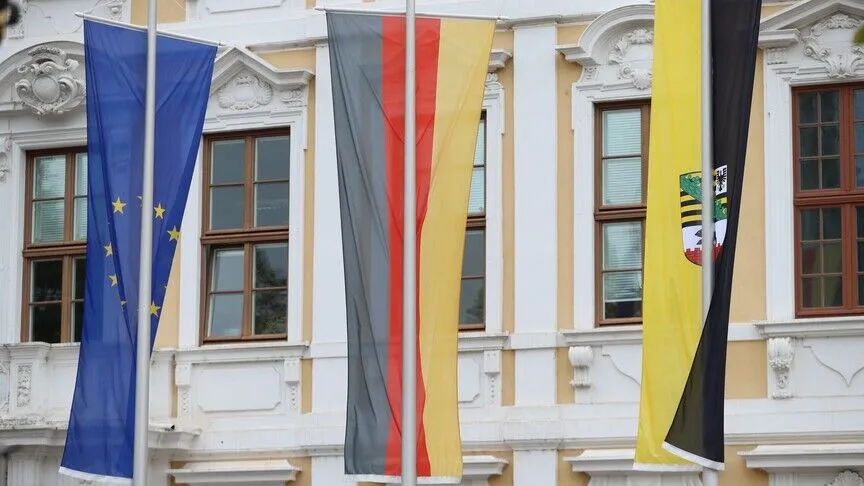
In Magdeburg, the capital of Saxony-Anhalt state, the public evaluated AfD's state parliament election victory for an AA correspondent.
Voter Lars Lindestedt stated that AfD caused considerable polarization during its election campaign, adding that AfD was not expected to win the election so clearly.
Emphasizing that AfD ran a good election campaign, Lindestedt said, "I think it touched a raw nerve with people. It probably addressed the right issues. Many people have social concerns. Everything has become more expensive. Except for paychecks, they remained the same."
Lindestedt pointed out that these issues worried people, saying, "I think these might be the most decisive reasons for AfD's election, the idea that the current situation cannot continue this way."
Lindestedt indicated that whether AfD can form a government will become clear over time, stating, "I think it will be difficult because the Left Party, the Greens, the Social Democratic Party (SPD), and the Christian Democratic Union (CDU) categorically reject cooperation. Perhaps the only party I think they could cooperate with is the Bündnis Sahra Wagenknecht (BSW). It's not yet clear if they will take that step."
Lindestedt argued that a potential minority government would be bad for the state, saying, "This would just mean stagnation, the state premier being unable to do anything. I don't think AfD would do that either. So it will be difficult."
Referring to the effects of federal policy on the state election, Lindestedt stated, "It is often said in the media that (German Chancellor Friedrich) Merz had a significant share in this election defeat. I also think this is a punishment for the federal government's policies. This certainly plays a role. Therefore, I believe this could also have effects on other state parliament elections."
Lindestedt expressed that it would be good for a government to be formed in Saxony-Anhalt, saying, "No matter how. It's also a possibility for all remaining parties to come together. This is still better than a minority government. This stagnation would be the worst option."
"People want change"
Lukas Daiser, an AfD election official in the state parliament elections, said he found the election result very good.
Daiser stated that he noticed people wanted a new beginning during the election campaign, saying, "People want change because we also see the situation in the country, there is increasingly uncontrolled migration, and in the economy, more and more companies are filing for bankruptcy. I believe AfD will change this situation. That's why AfD achieved such a great election victory."
Daiser, advocating for securing borders and deporting individuals who should not be in Germany, such as those who do not follow rules or cannot integrate, said, "Additionally, economic conditions need to be improved somewhat, meaning tax laws need to be regulated. Such issues are definitely among AfD's main agenda items."
Daiser stated that migrants who are legally in Germany, working, and abiding by the laws have no reason to fear, adding the following:
"AfD always says this too. The migrants who should be worried are those who do not belong here. These are, for example, those who commit crimes, those who are in the country illegally, or those who cannot integrate into society. We want to put an end to this. I think every country has the right to say that these people should leave. No one who behaves appropriately and abides by the laws needs to worry."
Daiser, expressing the view that forming a government would be difficult, said that no party achieved an absolute majority, and therefore BSW is in a position to decide who will form the government.
Daiser stated that the minority government option is not a good one, adding, "I would not advise (AfD's State Premier candidate) Ulrich Sigmund to enter a minority government either, because currently the whole country is looking at Saxony-Anhalt and AfD there. If AfD cannot achieve what it wants within a minority government, then AfD will be blamed."
"Election result stems from wrong policies"
Walter Schlevoigt also said that the election result stemmed from the wrong policies implemented so far.
Schlevoigt pointed out that government formation would be difficult, stating that he trusted some AfD deputies would switch parties.
"Most likely these will be from the CDU and will enable AfD to gain a majority," said Schlevoigt, expressing his belief that AfD would form the government in the state.
Schlevoigt, stating that he was not pessimistic like many others, said, "Saxony-Anhalt will not change the world. Nor will AfD overturn Germany with this result. What AfD can achieve is to continue to be successful if those in Berlin continue in the same way."
Ute Lau also stated that she felt the elections would turn out this way because people were angry with politicians, adding, "They (politicians) probably needed to take a hit."
Lau noted that she expected everyone to behave reasonably towards each other in government formation efforts, and that politicians merely fighting was annoying.
Fabienne Uth also said that the election result was like a "day of mourning."
Uth, underlining that citizens are angry, stated, "AfD is the only party offering real radical change, but one needs to take a look at history and realize that all of this has happened before. Voters here should also be a bit more conscious and make smart choices instead of blindly voting for the first option."
Uth, arguing that Friedrich Merz's policies played a big role in the election result, said, "Because we owe the citizens' anger to Friedrich Merz or the governments before him."
Retired Burckert Techau also expressed the view that the result in the state parliament elections was "excellent," saying, "This should have happened much earlier. Germans accepted everything from the CDU, SPD, and Greens for too long. We should have woken up much earlier."
Techau stated that he believed AfD would try to change things, adding, "But everything has been brought to such a bad point that it's not possible to change it so quickly. It won't happen overnight; it needs time, but I bet AfD will make the most reasonable choices from this."
Techau, arguing that AfD and BSW converge on many common issues, noted that these two parties could form a coalition.
Comments
0 commentsNo comments on this article yet. Be the first!