
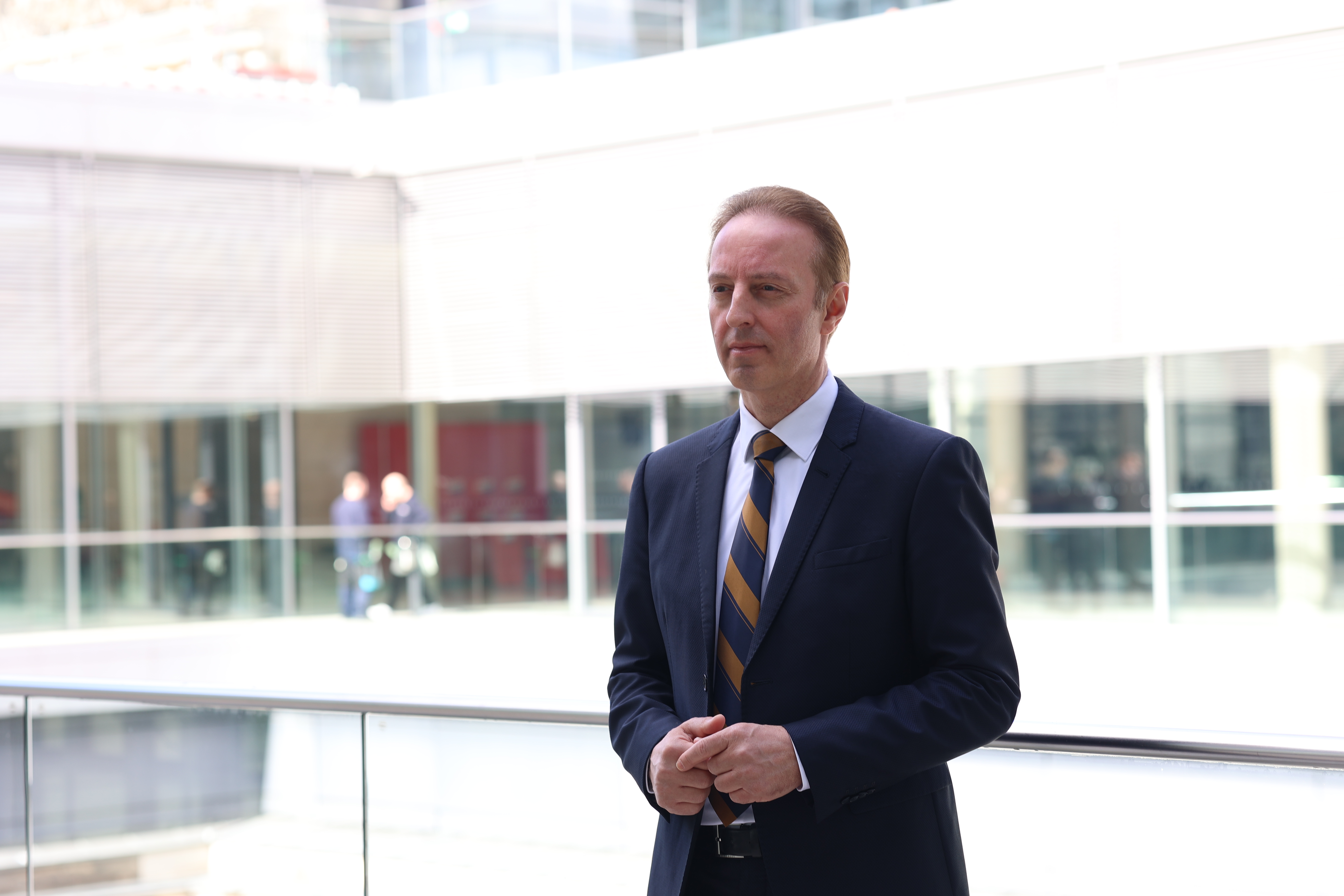
While Die Linke becoming the leading party with 25.7% and the SPD falling to 12.1% in Berlin brought new discussions to German politics, SPD Federal Deputy Macit Karaahmetoğlu stated that the election results contained important messages for democratic parties. Karaahmetoğlu used the expressions, regarding the success of Die Linke's leader of Turkish origin, Elif Eralp, “As a social democrat, I envy her, but as someone of Turkish and immigrant origin, I am proud of her.”
The Berlin State Parliament elections and the Mecklenburg-Vorpommern state elections, held in Germany on September 20, 2026, witnessed remarkable changes in political balances.
In Berlin, Die Linke came in first with 25.7% of the votes, while the CDU received 18.8%, AfD 16.3%, the Greens 14.3%, and the SPD 12.1%. Thus, the SPD achieved one of its lowest results in its history in the Berlin state parliament elections.
In Mecklenburg-Vorpommern, AfD came in first with 38.2%, while the SPD received 35.5% of the votes. Die Linke remained at 6.5%, and the Greens at 5.7%. The CDU, with 4.9%, failed to cross the 5% election threshold and could not enter parliament.
Karaahmetoğlu: “I Am Proud of Eralp's Success”
Evaluating the election results, SPD Federal Deputy Macit Karaahmetoğlu, particularly in Berlin, drew attention to the result achieved under the leadership of Die Linke's politician of Turkish origin Elif Eralp.
Karaahmetoğlu evaluated Eralp's success from a different perspective in terms of her social democratic identity, and from another perspective in terms of her Turkish and immigrant origin.
“As a social democrat, I certainly envy Elif Eralp's success. But as someone of Turkish and immigrant origin, I am proud of her” said Karaahmetoğlu, stating that Eralp's election campaign carried an important message regarding the representation of people of immigrant origin in German politics.
In his assessment of Eralp's success, Karaahmetoğlu made the following statements:
“I also see an important message in Eralp's success: There is no need to wink at the right, target immigrants, or generate fear through immigration to win elections. She centered people's real problems without compromising her own identity and was able to reach broad segments of society.”
Karaahmetoğlu, stating that it is important for people with an immigrant background in Germany to become more visible in the highest echelons of politics for the country's social transformation, said that Eralp's result also holds significance in this regard.
“AfD's Rise Cannot Be Explained Solely by Protest Votes”
Karaahmetoğlu, also touching upon AfD becoming the leading party with 38.2% in the Mecklenburg-Vorpommern elections, stated that democratic parties need to address more comprehensively why voters are turning to different political preferences.
Karaahmetoğlu said, “Neither underestimating the vote percentages AfD achieved nor mimicking the voters' anger is a solution. Democratic politics needs to rebuild trust.”
Karaahmetoğlu, arguing that it is no longer sufficient to consider all votes given to AfD solely as “protest votes,” said that the high vote percentages indicate a permanent social basis that politics must take into account.
“If a political movement receives the votes of almost four out of ten voters in a state, we are facing a serious political reality that is not merely a temporary protest” said Karaahmetoğlu, stating that democratic parties must first question why the distance between them and the voters has grown.
“First, We Must Ask Ourselves Why We Lost People”
According to Karaahmetoğlu, democratic parties should not reduce the discussion solely to the question of “How will AfD be stopped?”
Karaahmetoğlu stated that it needs to be questioned whether the expectations regarding the daily problems of workers, retirees, families, young people, and those living in rural areas are sufficiently met by democratic parties.
Karaahmetoğlu, emphasizing that trust in the state's problem-solving capacity is also important, said that it needs to be understood why people are increasingly expressing their anger through anti-system political choices.
“SPD Must Resonate with People's Lives Again”
Karaahmetoğlu, stating that the Berlin elections contained an important message for the SPD, expressed that social democracy needs to once again put forward policies that produce solutions to concrete problems.
Karaahmetoğlu said that workers should feel that they are getting the value for their labor, families should experience less anxiety about housing and their children's future, and retirees should be able to look at their economic future with confidence.
Karaahmetoğlu, drawing attention to the importance of state institutions appearing before citizens not as delayed or difficult-to-reach structures, but as problem-solving institutions, said, “We must show people not only what we are against, but also what we will change.”
“Mimicking AfD's Language Is Not a Solution”
Karaahmetoğlu also argued that democratic parties should not mimic AfD's political discourse in response to its rise.
Karaahmetoğlu, stating that instead of “copying AfD's language,” democratic politics needs to strengthen its own credibility again, said that this has two main pillars.
The first of these is to produce concrete solutions to the problems people face in daily life, and the second is to clearly explain the consequences of AfD's stance towards democratic institutions, the political system, and social cohesion.
Karaahmetoğlu said, “We can only narrow the ground on which AfD gains strength by democratic politics strengthening its own credibility again.”
The SPD politician stated that he would continue to fulfill his responsibility in this discussion and contribute to debates regarding the future of social democracy.

Comments
0 commentsNo comments on this article yet. Be the first!