
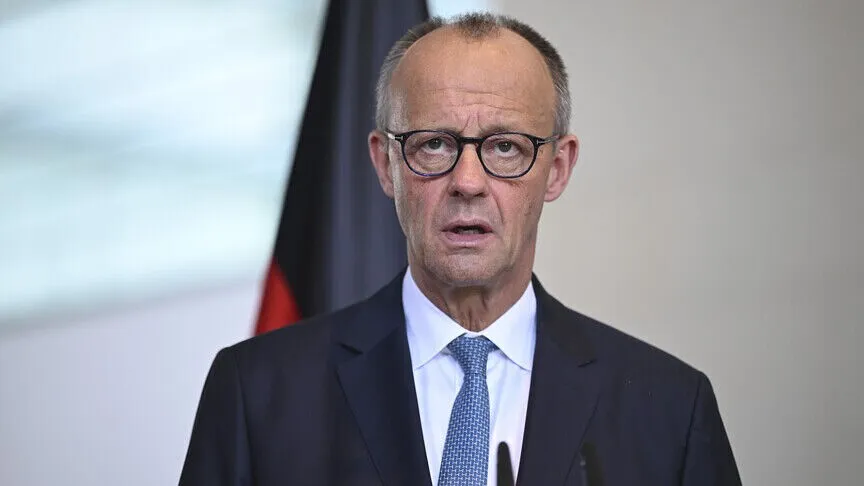
In public opinion polls conducted ahead of the elections to be held on September 6 in the state of Saxony-Anhalt, the Alternative for Germany (AfD) is seen to be clearly ahead with over 40% of the vote. While the AfD ranks first in the polls with 40-43%, the Christian Democratic Union (CDU), led by German Chancellor Friedrich Merz, is in second place with 22-23%.
The Social Democratic Party (SPD), the junior partner in the government, has a vote share of 7-9%, and the Greens are in the 5-6% range.
As the AfD has the possibility of gaining an absolute majority in the parliament with the vote share it will receive in this state and coming to power in a German state for the first time, all eyes in Germany will be on the elections to be held on September 6.
Journalist and author Jana Hensel, along with political scientist and sociologist Steffen Mau, made statements to an Anadolu Agency correspondent regarding the AfD's high vote share in the eastern states of the country and the potential effects of the election results on national politics, ahead of the elections in Saxony-Anhalt.
Hensel stated that there are many reasons for the AfD's high vote share in the eastern states, adding that despite 36 years having passed since Germany's reunification, the eastern states have not reached the prosperity level of the western states of the country.
Emphasizing that there are "very large economic and social differences," Hensel also stated that domestic policy discussions are conducted from a West German perspective.
Hensel conveyed that many people living in eastern Germany feel they are "living in the country's periphery" and are "unseen".
Hensel stated that Saxony-Anhalt is a small state, but the elections to be held there will have significant effects, arguing that the AfD has grown stronger during Merz's chancellorship.
Hensel said, "During Friedrich Merz's tenure, the AfD got out of control. The AfD, which for a long time received around 20% of the vote in eastern Germany, has now reached 40% in the polls."
Hensel stated that this rise began in the final months of the previous government's term, adding, "During Friedrich Merz's term, this party recorded a very significant increase. Friedrich Merz is largely responsible for the AfD's high support."
Hensel stated that she would not currently say what might happen in Berlin in the coming period, remarking, "I don't think the government will fall. However, there is at least a question mark over whether Friedrich Merz will continue his duty as Chancellor of Germany."
"AfD is a great danger to democracy"
Hensel noted that this election serves as a vote on the federal government's policies and Friedrich Merz's reforms.
Hensel stated that the AfD is an extremely radical organization in the state of Saxony-Anhalt, saying, "The AfD is a great danger to democracy."
Hensel pointed to the AfD's Saxony-Anhalt election program, explaining that it calls for a toughening of migration policy and aligning cultural and educational policy with an ideological line, and stated that this is a very dangerous political program that foresees radical changes.
Hensel warned that if the AfD comes to power, the social climate in the country will harden, saying, "Racism and anti-immigrant rhetoric would virtually start coming from a state government, that is, from the state premier. This would largely harden the social atmosphere."
To a question about whether the German government's foreign policy has an effect on the increase in AfD votes, Hensel replied, "The AfD benefits greatly from nothing else as much as from Russia's war of aggression against Ukraine."
Political scientist and sociologist Mau also stated that the elections in Saxony-Anhalt are important, saying, "They will also have effects on the federal government in Berlin. They will put Chancellor Merz under great pressure."
Mau noted that if the AfD forms the government in this state, there could be a fundamental change in Germany.
Answering a question about why the AfD receives high votes in the east of the country, Mau replied, "While the population is generally decreasing, migration is increasing. Therefore, shrinking societies often fear migration and new immigrants. This is a situation we can observe not only there (in Saxony-Anhalt) but also in other regions in the east of the country."
Political scientist Dr. Benjamin Höhne also stated that the public's concern is growing over the possibility of the AfD taking on governmental responsibility in the state of Saxony-Anhalt, adding that the AfD has been leading in public opinion polls in Saxony-Anhalt for a long time.
Höhne pointed out that the AfD increased its votes in this state and generally in eastern Germany in the last federal parliament and European Parliament elections, noting that the AfD hopes to gain a majority in the Saxony-Anhalt state parliament.
However, Höhne stated that recent polls show smaller parties like the Greens could potentially enter parliament, and the AfD's vote share has slightly decreased, thus indicating that the scenario of the AfD forming a government alone has somewhat diminished for now.
Höhne stated that although it does not seem likely at the moment, if the AfD takes part in the state administration, not only the people in Saxony-Anhalt but the country as a whole could be affected, adding, "This would also have effects on democracy in general."
Höhne pointed out that in Germany, states participate in the government's legislative process through the Federal Council (Bundesrat), warning that AfD ministers there could potentially distance themselves from Germany's consensus-based decision-making methods, thereby making governance at the federal level somewhat more difficult.

Comments
0 commentsNo comments on this article yet. Be the first!