
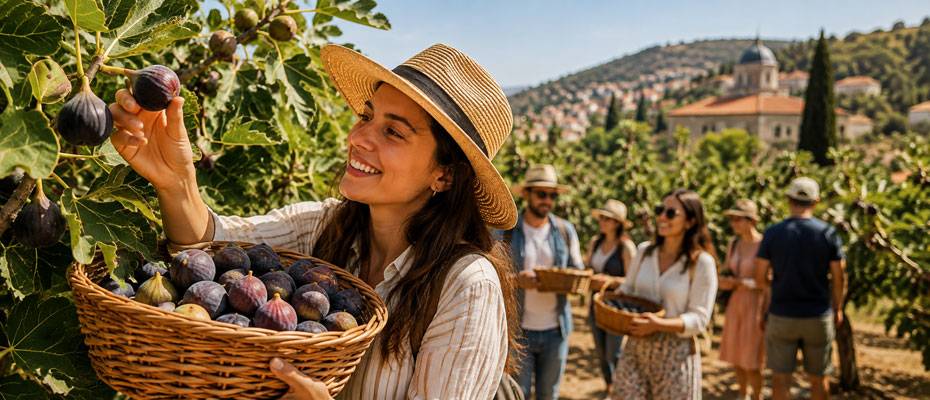
Experiences that allow travelers to become part of local life instead of just visiting a destination are gaining increasing importance in travel preferences. Following grape harvest, olive harvest, lavender fields, and gastronomy routes, fig harvest is now also being added to the options that bring agricultural production together with tourism.
The “Havran Black Fig Harvest Tour,” organized in cooperation with Flygroup Travel Agency and Havran Municipality, brought 45 visitors together in Havran district of Balıkesir. While participants picked figs directly from the branch, they followed a program that also included the district's history, cultural heritage, natural riches, and local products.
New Harvest Routes from Figs to Olives and Mandarins
Yıldırım Baydar, General Manager of Flygroup Travel Agency, states that Balıkesir has tourism potential not only with its festivals but also with its nature and geographically indicated products, pointing out that there are still untapped opportunities, especially in the districts.
Baydar, stating that they operate with the slogan “Edremit Travels with Us,” says that after the fig harvest in Havran, they plan to organize mandarin, olive, and pomegranate harvest tours. Joint studies with sector stakeholders to strengthen Edremit's position in congress tourism are also among the plans.
The Havran Black Fig, central to the tour, has been registered with a geographical indication by the Turkish Patent and Trademark Office. The product is known for its thin skin, its edibility with the skin, and its unique aroma.
Agriculture and Tourism Meet at the Foothills of Kaz Mountains
Havran, at the foothills of Kaz Mountains, offers suitable conditions for the production of figs, as well as olives, pomegranates, and mandarins, with its climate and fertile soil. Havran Mayor Emin Ersoy states that the clean air the district receives from two sides contributes to the flavor of agricultural products.
During the harvest tour, visitors picked figs directly from the trees and also had the opportunity to see the environment where the product grows up close. Thus, the product that consumers encounter on their tables became a direct part of the tourist experience.
Havran Municipality is also trying to transform the ideas that emerged from the Havran Tourism Workshop held in June into new projects. While a Street Rehabilitation Project named “Havran, a Hidden Paradise, Legacy from the Ottomans” is being carried out in the district, work is also continuing on the Havran Water Sports and Caravan Camp Project. The caves in the İnboğazı region are aimed to be opened to tourism after research is completed.
History Also Added to the Harvest Route
The program was not limited to fig orchards. Participants visited the Kocaseyit Monument, built in the name of Seyit Ali Çabuk, known as Seyit Onbaşı, one of the symbolic figures of the Çanakkale War.
The group, listening to Seyit Onbaşı's story from the Çanakkale Front from his grandson Muhammed Yıkar, thus embarked on a journey into the region's recent history after the agricultural experience.
Another stop on the route was the City Museum, which tells the thousands of years of Havran's past. In the venue organized with a “living museum” concept, the historical development of the district is conveyed to visitors.
Terzizade Mansion, Where Atatürk Was a Guest
Within the scope of the tour, Terzizade Mansion was also visited. Mustafa Kemal Atatürk was hosted in this three-story mansion when he came to Havran on February 6, 1923. The building is also known as the historical venue that hosted the meeting of Atatürk and Seyit Onbaşı.
Thus, in the cultural leg of the tour, Havran's local history and important names and events of Turkish history came together on the same route.
Local Flavors Part of the Experience
Havran's gastronomic products were also included in the program. Participants visited the İda Flora factory, where entrepreneur Funda Filiz Döner produces soap from cold-pressed olive oil, and received information about the production process.
Visitors who also tasted Höşmerim, clove-flavored roasted chickpeas, and regional dairy products had the opportunity to purchase local products. Thus, the harvest tour ceased to be merely an agricultural event and transformed into a one-day program connecting local producers, gastronomy, history, and cultural heritage.
Havran Prepares to Grow Harvest Tourism
The model that started with figs is planned to be continued with mandarin, olive, and pomegranate harvests. This approach also aligns with the growing trend of experience-oriented travel in tourism.
Seeing a product where it grows, participating in the harvest, meeting producers, and exploring the region's history and cuisine on the same day transforms agricultural production into a travel experience in itself. Havran also aims to spread this potential throughout the year by utilizing different harvest periods. Visual: © Image generated with artificial intelligence

Comments
0 commentsNo comments on this article yet. Be the first!